



An integrated Christmas Tree is a consolidated unit where the lower master valve, upper master valve, and a flush valve are combined into a single assembly. This saves operators operational time during installation.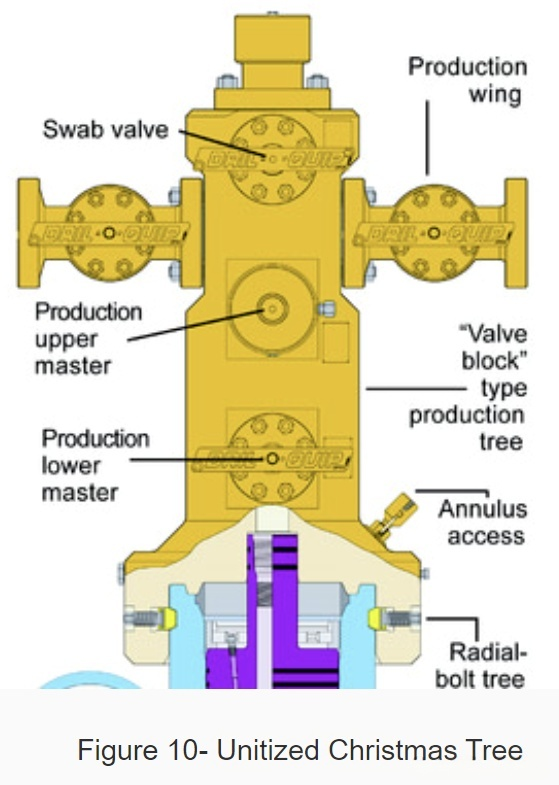
Wellhead and Christmas Tree
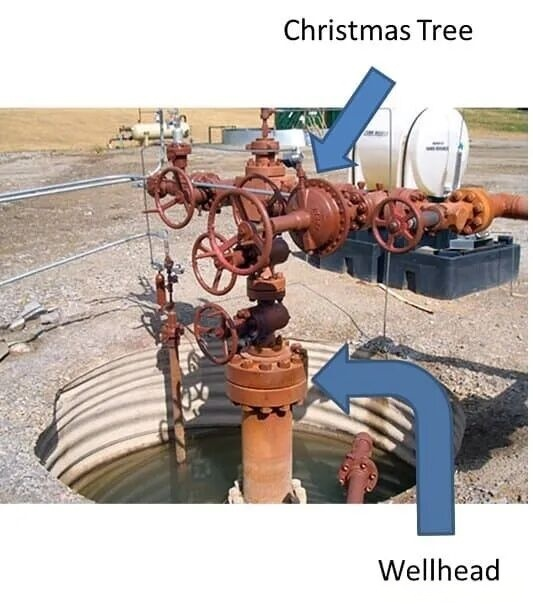
The wellhead is the component located at the surface of an oil or gas well, providing structural support and a pressure-containing interface for drilling and production equipment.
The primary function of the wellhead is to provide a support point and pressure sealing device for the casing string extending from the well bottom to the surface pressure control equipment.
During well drilling, surface pressure is controlled by the Blowout Preventer (BOP). If pressure is not controlled by the drilling fluid column during drilling, the wellbore, wellhead, and BOP may rupture, leading to a blowout incident.
Upon completion of drilling, completion operations are performed to establish connection with the reservoir rock and form a conduit for well fluid flow. The Christmas Tree installed atop the wellhead enables surface pressure control, containing isolation valves and chokes to regulate well fluid flow during production.
The wellhead is typically welded to the first casing string and fixed in place during drilling, forming the complete structure of the well. For exploratory wells that will later be abandoned, the wellhead can be recovered, refurbished, and reused.
Offshore, wellheads located on production platforms are called surface wells; if located underwater, they are termed subsea wells or mudline wells.
Design Specifications
Industry specifications for wellhead systems (including materials, dimensions, testing procedures, and pressure ratings) are:
API 6A: Specification for Wellhead and Tree Equipment
ISO 10423: Wellhead and Tree Equipment Standard
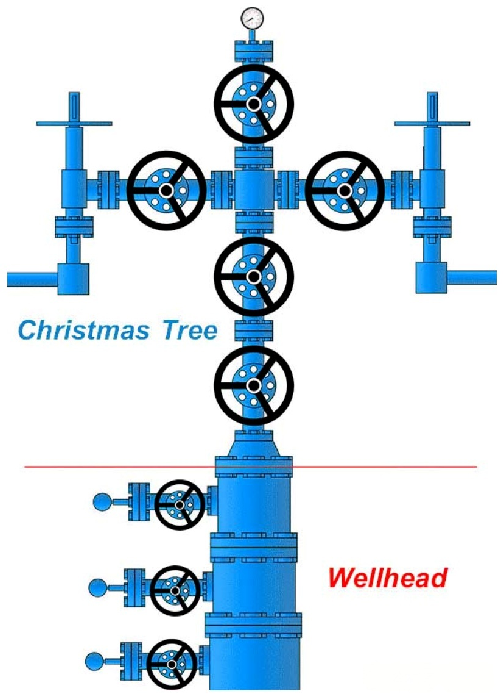
What is a Christmas Tree Valve?
A Christmas Tree valve is a system comprising valves, chokes, piping, and instrumentation, named for its resemblance to a decorated Christmas tree. It is crucial to emphasize that the Christmas Tree valve is separate from the wellhead; it acts as the bridge between downhole conditions and surface conditions. After production commences, these valves are installed atop the wellhead to direct and control the flow of produced fluids outward.
These valves serve many other purposes, such as pressure relief, chemical injection, safety equipment monitoring, and electrical interfaces for control systems. They are commonly used on both subsea oil wells in offshore platforms and surface wells. This series of components is essential for the safe extraction of petroleum, natural gas, and other fuel resources buried deep within the earth, providing core connection points for all aspects of the well.
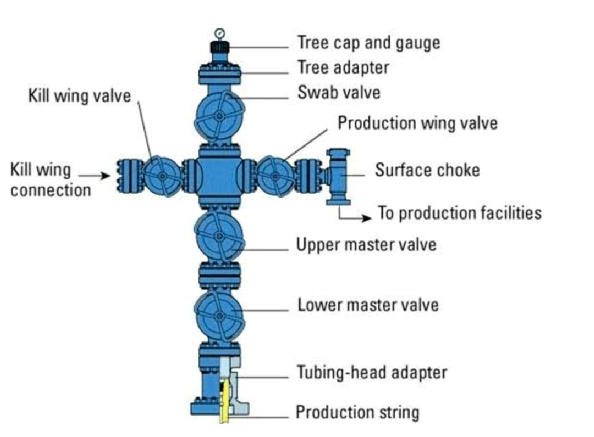
The image above shows a simple Christmas Tree with five valves, but actual Christmas Tree valve systems are often much more complex. Most Christmas Tree valves are custom-manufactured, making it difficult to explain the specific working principles of all types.
Lower Master Valve
The Lower Master Valve is a valve used to control flow from the wellhead into the tree assembly. In most cases, it is manually operated and remains in a restricted, partially open state during production.
Upper Master Valve
The Upper Master Valve is a safety device used when the Lower Master Valve fails or during maintenance of the Christmas Tree. It is typically a remotely operated valve that automatically closes upon receiving a safety signal to stop all flow into the tree.
Kill Wing Valve
The Kill Valve is another manually operated valve and serves as the connection point for injection. Fluids such as corrosion inhibitors, methanol, and dehydration formulas can be injected through this valve. They are also known as side arm valves or secondary wing valves.
Production Wing Valve + Isolation Valve
The Production Wing Valve is typically arranged 180 degrees opposite the Kill Wing Valve. It is an automatically operated component requiring positive hydraulic pressure to remain open. During emergencies or maintenance, it prevents injection/flow into the well and is usually combined with a choke to control flow and pressure within the well. This choke is considered the “faucet” for fuel flow, making flow control critical for this component.
Swab Valve + Cap and Gauge
The Swab Valve is another manually operated valve, providing a direct vertical pathway for downhole operations. The T-Cap and pressure gauge serve as visual indicators of which valve is open; for example, if the kill valve is open and the swab valve is closed, the pressure gauge should read 0 psi (no pressure), whereas if the production valve is open and the swab valve is also open, the pressure gauge should display the value specified by the well operator. They may also include digital temperature valves and other monitoring systems to ensure well safety, as excessive manual valves leave room for human error.
Summary
Selecting a Christmas Tree valve is not merely about purchasing the right brand or size. Christmas Tree valves are specially designed equipment that must match all other systems in the drilling application, including pumps, control systems, safety devices, and other parts of the well.
Wellhead or Christmas Tree? What is the Difference?

In the oil and gas industry, the terms “wellhead” and “Christmas Tree” are often used interchangeably. However, the wellhead and Christmas Tree are entirely different pieces of equipment. Both are crucial for oil and gas production and are equipped with valves and other devices to help control and direct material flow.
The wellhead controls pressure during drilling and production operations. Located at the well surface, between the casing and the rig floor, it provides safe and controlled access to the active well. The wellhead supports the casing and provides pressure seals for the casing string. During drilling, it supports the Blowout Preventer (BOP); during completion, it supports the frac head; and after completion, it supports the production tree. The wellhead exists during drilling, completion, and production phases.
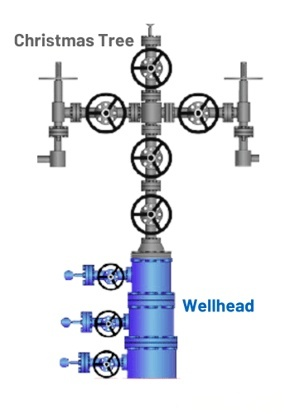
The primary purpose of the Christmas Tree is to control the inflow and outflow of resources (usually oil or gas) from the well during production. After the drilling process is completed, the Christmas Tree is transported to the site and installed on the wellhead. The Christmas Tree consists of a series of valves, nipples, instrumentation, and chokes.
A typical Christmas Tree assembly contains five valves in total, each with a specific function:
Kill Valve: This valve injects fluids like drilling mud or brine into the well to control pressure. It is commonly used during well intervention and maintenance activities to “kill” the well, i.e., control pressure and stop fluid flow.
Swab Valve: Located at the top of the Christmas Tree, the swab valve provides access to the well for wireline or coiled tubing operations. This enables well intervention, maintenance, or logging without killing the well. It plays a vital role in maintenance and troubleshooting operations.
Production Wing Valve: This valve controls the flow of oil and gas from the well to production facilities. It can be opened or closed to start or stop production and is also used to regulate flow to optimize production or manage potential issues like sand production.
Upper Master Valve: The Upper Master Valve is one of the primary isolation valves, capable of completely shutting off flow from the well. It is typically used in emergencies to rapidly and effectively stop oil and gas flow, providing critical protection for safety and environmental preservation.
Lower Master Valve: The Lower Master Valve is another primary isolation valve, functioning similarly to the Upper Master Valve. It provides redundancy, ensuring a backup valve is available to shut in the well should the Upper Master Valve fail for any reason. Having both Upper and Lower Master Valves provides operators with greater flexibility and enhanced safety measures.
These components work together to regulate pressure, control flow, and provide access to the wellbore during completion and production phases. It derives its name from its resemblance to a decorated Christmas tree. This critical equipment plays important roles in downhole operations, pressure relief, chemical injection, well monitoring, flow composition and rate, and valve and choke position feedback.
How are S-Type and FS-Type Seals Used in Wellheads and Christmas Trees?
Precision-molded S-Type and FS-Type seals manufactured by CDI feature anti-extrusion springs suitable for high-pressure and wide-temperature ranges. S-Type and FS-Type seals offer maximum extrusion resistance in demanding High-Pressure High-Temperature (HPHT) sealing environments. Our S-Type seals are known as advanced replacements for traditional three-piece T-seals or O-rings with back-ups. Metal girdle springs are integrated into uniquely designed elastomeric sealing elements. This enables them to withstand large extrusion gaps (up to 0.125 inches). FS-Type seals are used in applications with larger extrusion gaps or where equipment diameters may be inconsistent, serving as an alternative to S-Type seals. FS-Type seals combine metal girdle springs with uniquely designed elastomeric sealing elements. This design can seal areas requiring high seal deflection to compensate for variations in pipes, casings, or large-diameter components. The FS seal is an internal diameter seal with a thicker cross-section, used for larger extrusion gaps and rougher casing surfaces.
CDI produces high-quality custom and industry-standard sized S-Type and FS-Type seals using Nitrile Rubber (NBR), Hydrogenated Nitrile Rubber (HNBR), and Fluoroelastomer (FKM) materials to meet unique customer sealing needs, supplying them promptly throughout their business cycle.
Christmas Tree or Wellhead Assembly?
A Christmas Tree is an assembly of valves, nipples, and fittings used for oil wells, gas wells, water injection wells, disposal wells, gas injection wells, condensate wells, and other types of wells. It gets its name from its resemblance to a decorated Christmas tree.
Often, the terms “wellhead” and “Christmas Tree” are used interchangeably; however, they are entirely different equipment. To use a Christmas Tree, a wellhead must exist; however, a wellhead can exist without a Christmas Tree during drilling operations. Producing surface wells that require pumps (pumping units, nodding donkeys, etc.) typically do not use any Christmas Tree because there is no requirement for pressure sealing.
Over the past few decades, the complexity of tree manifolds has increased. They are typically manufactured from steel blocks containing multiple valves rather than being assembled from multiple flanged valves.
The primary function of the tree is to control the inflow or outflow of fluids, usually oil or gas.
Christmas Trees often provide various additional functions, including chemical injection points, means for downhole operations, pressure relief means (such as annulus venting), and connection points for tree and well monitoring (e.g., connections for devices measuring pressure, temperature, corrosion, erosion, sand detection, flow, fluid composition, valve and choke position feedback, Downhole Pressure and Temperature Sensors (DHPT), etc.).
What is the Purpose of the Wellhead Assembly?
In producing wells, chemicals, alcohols, or petroleum distillates may be injected to prevent and/or resolve production problems (such as blockages). The wellhead assembly is also used to control gas injection or water injection in producing or non-producing wells to maintain economic “production” levels for other wells in the area (oilfield). The control system connected to the wellhead assembly controls the Downhole Safety Valve (SCSSV), while the wellhead assembly serves as the connection and conduit between the control system and the SCSSV.
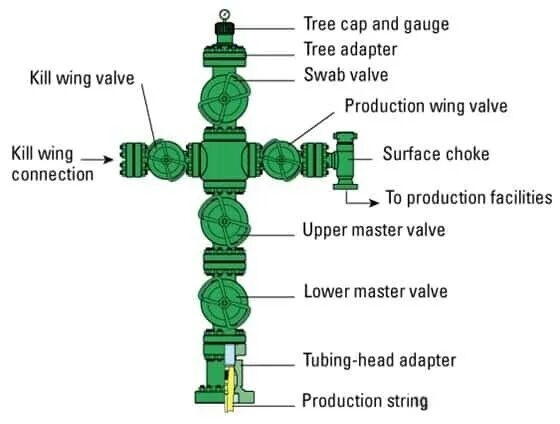
As you can see, even on this schematic diagram of a Christmas Tree, there are five valves. They are the Choke Wing Valve, Swab Valve, Production Wing Valve, Upper Master Valve, and Lower Master Valve. When operators, the well, and the facilities are ready to produce and receive oil or gas, the valves open, allowing formation fluids to flow in and through the pipelines. Understanding the location of these valves and their role in transporting natural gas from the wellbore to the customer is important.
Component Definitions
The two lower valves are called Master Valves (Upper and Lower) because they are located in the flow path that well fluids must pass through to reach the surface.
The Lower Master Valve is typically manually operated, while the Upper Master Valve is often hydraulically actuated.
Hydraulic Christmas Tree wing valves are typically designed as fail-safe closed, meaning they require continuous hydraulic pressure to remain open.
The valve on the right-hand side is usually referred to as the Production Wing Valve or Flow Wing Valve, as it is located in the flow path leading to production facilities.
The valve on the left-hand side is usually referred to as the Choke Wing Valve. It is primarily used for injecting fluids such as corrosion inhibitors or methanol to prevent hydrate formation.
The top valve is called the Swab Valve, located in the path used for downhole operations such as wireline and coiled tubing operations. A “Choke” is a device that can be either fixed or adjustable, used for:
Controlling gas flow, also known as volume; or
Creating downstream pressure, also known as backpressure.
We hope this helps you better understand the difference between a wellhead and a Christmas Tree. However, if you have any questions, please feel free to contact us.
Contact :Jessie Zhou
Mobile/Whatsapp:+0086-18109206861
Email: energy@landrilltools.com
Post time: Jun-05-2026


 5-1203,Dahua Industrial Zone, No.2 Yunshui Road,Hi-tech development zone, Xi'an, 710065,China
  86-13609153141

