



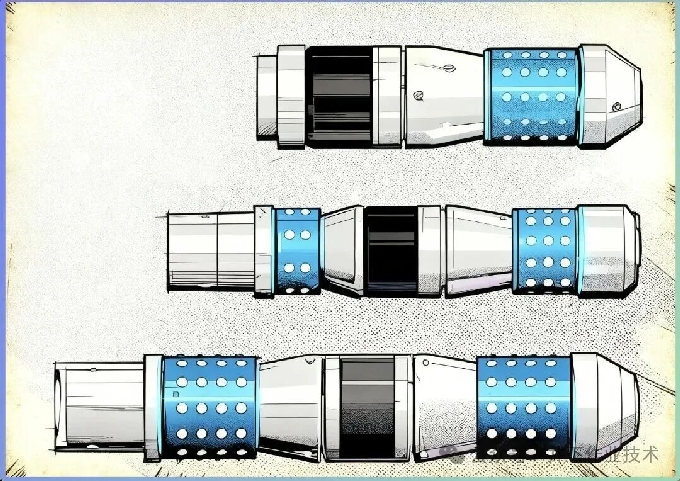
As a new-generation intervention-free wellbore isolation tool currently promoted as a mainstream solution in the oilfield sector, the dissolvable bridge plug‘s most significant technological breakthrough lies in abandoning the traditional “must be manually removed after isolation” operation mode of conventional plugs. After fracturing, the tool autonomously dissolves and disintegrates in the downhole environment—eliminating the need for milling or fishing—and the wellbore directly restores to full bore, truly achieving integrated “fracturing-isolation-self-dissolution” operations. This article systematically breaks down the material properties, structural principles, standardized operational parameters, applicability essentials for various well conditions, and on-site risk management solutions for dissolvable bridge plugs.
I. Field Application Positioning of Dissolvable Bridge Plugs
Previously, zonal isolation in the field primarily relied on retrievable bridge plugs and composite bridge plugs. While these tools offer stable isolation performance and broad adaptability, they suffer from unavoidable shortcomings: after the treatment is completed, a second intervention must be made to mill or fish them out. Once complications arise,such as wellbore scaling, sand burial, or rubber element aging and adhesion, complex accidents such as difficulties in releasing the plug, milling obstructions, and fishing failures readily occur, significantly driving up operational costs and timelines.
The dissolvable bridge plug represents an iteratively upgraded new-generation wellbore isolation tool, with its core advantage being the elimination of later workover intervention. The tool is made of special dissolvable alloy materials, leveraging downhole temperature and the electrolyte environment of formation water to initiate electrochemical reactions, autonomously corroding, pulverizing, and gradually dissolving away. Throughout the process, there is no residual bulk tool and no risk of fish, making it suitable for highly efficient development wells with long horizontal sections and multi-stage fracturing—a core new technique for cost reduction and efficiency improvement in today’s oilfields.
II. Core Materials and Standard Technical Parameters for Field Applications
The dissolvable bridge plug as a whole is integrally formed from magnesium-based dissolvable alloy + degradable fluoro-rubber sealing materials. The entire tool string contains no non-dissolvable components such as cast iron or hardened steel, adapting to the vast majority of oil and water well conditions in China. The general standard technical parameters for field applications are as follows:
1. Applicable downhole temperature range: 80°C – 170°C (high-temperature variants can reach up to 200°C)
2. Rated pressure bearing capacity: 30 MPa – 70 MPa (maximum up to 90 MPa)
3. Dissolution period in conventional formation water environment: approx. 5–10 days
4. Artificial accelerated dissolution media: 3%–5% KCl (potassium chloride) solution, 0.5%–1% weak organic acid flowback fluid
5. Setting initiation pressure: 16–25 MPa
6. Standard shear/release force for disconnect: 26–32 MPa
7. Compatible casing sizes: 5.5″ (139.7 mm), 7″ (177.8 mm) casing
8. Final state after dissolution: fine powder, particles ≤ 2 mm, fully removable from the wellbore with flowback fluid
In actual operations, the dissolution rate is dynamically influenced by the downhole environment. Higher formation temperature and higher water salinity accelerate the electrochemical reaction rate and shorten the dissolution period; low-temperature, heavy crude oil, and low-salinity wellbores delay the corrosion process, with the dissolution period extending up to 12–18 days in the longest cases.
III. Overall Structural Composition
Distinct from the complex metallic hardened structures of traditional bridge plugs, all core components of the dissolvable bridge plug are made of degradable materials, fundamentally eliminating the risk of wellbore residue:
1. Dissolvable alloy center tube: The main load-bearing structure of the tool, featuring uniform stress distribution and stable dissolution rate, with no localized residue issues.
2. Dissolvable cone assembly: Drives the slips to expand outward for positioning during setting; it is the core transmission component for isolation and anchoring, fully corrodible and decomposable in the later stage.
3. Dissolvable alloy slip assembly: Designed with hardened engagement teeth, it firmly anchors to the casing inner wall after setting, ensuring no slippage or pressure leakage throughout the fracturing process.
4. Degradable polymer rubber element: High temperature and high pressure resistant; axially compressed for radial expansion to seal the zone, fully swellable and decomposable in the later stage.
5. Dissolvable disconnect shear pins: Precisely sheared upon reaching the rated pressure, achieving separation of the running tool from the downhole bridge plug with extremely strong stability.
IV. Core Operational Advantages of New-Type Dissolvable Bridge Plugs
Compared to traditional composite bridge plugs and retrievable plugs, the field advantages of this new-type wellbore isolation tool are prominent:
1. Streamlined workover procedures, cost reduction,and efficiency improvement: Completely eliminates subsequent operations such as milling, fishing, and wiper trips, substantially compressing the well construction cycle and reducing equipment and labor costs.
2. Eliminates downhole complex faults: No risk of cutting accumulation, stuck pipe, or dropped tools, fundamentally avoiding secondary downhole accidents and enhancing operational safety.
3. Protects casing integrity: No mechanical milling operations are required, avoiding wear, scratches, and deformation damage to the casing inner wall, and long-effectively ensuring wellbore integrity.
4. Zero residue and full bore in the wellbore: The tool completely dissolves with no remnants, and the wellbore maintains complete full bore, reserving ample operational space for later water shutoff, zonal adjustment, and stimulation measures.
5. Strong operational continuity: Multi-stage fracturing can be performed consecutively with simple procedures and extremely high efficiency, adapting to large-scale horizontal well development operations.
VI. Field Operation Shortcomings and Risk Control Measures
Based on years of field application experience, dissolvable bridge plugs have certain operational limitations that require targeted prevention and control:
Existing shortcomings:
The dissolution rate is relatively slow in low-temperature and low-salinity wellbores; heavy crude oil and high-viscosity well fluids will encapsulate the tool surface, blocking electrolyte contact and delaying the corrosion and dissolution process; the procurement cost of the tool is higher than that of conventional composite bridge plugs.
Control measures:
1. Before construction in low-temperature and low-efficiency wells, pre-inject 3%–5% KCl solution to optimize the downhole electrolyte environment, activate the dissolution reaction, and shorten the dissolution period.
2. After fracturing is completed, retain an appropriate amount of formation water to avoid long-term encapsulation of the tool by pure oil phase, ensuring the continuous and stable progress of electrochemical corrosion.
3. Strictly match the tool model according to downhole temperature and pressure parameters, preventing use beyond temperature and pressure limits to avoid isolation failure and abnormal dissolution.
VII. Summary of Optimal Applicable Well Conditions
Prioritized well conditions: Horizontal well multi-stage fracturing, reservoir stimulation, high-yield treatment wells, and development wells requiring rapid commissioning.
Recommended application scenarios: Key oil and gas wells with intact casing free from deformation, stable wellbore water quality, and requiring multiple treatment operations in the later stage.
Non-adaptable scenarios: Long-term dry wells without fluid, severely scaled and blocked wells, and electrolyte-free dead water zones, where dissolution stagnation and isolation failure problems readily occur.
VIII. Conclusion
As an iteratively upgraded new-type wellbore isolation tool, the dissolvable bridge plug completely overturns the old operation mode of “isolation + cleanup” for traditional bridge plugs. Relying on stable mechanical sealing pressure-bearing performance and controllable electrochemical self-dissolution characteristics, it achieves the operational effect of reliable isolation, efficient construction, autonomous disappearance after completion, and a traceless wellbore.
Under the general trend of efficiency improvement and cost reduction in oilfields and the simplification of workover procedures, the dissolvable bridge plug has become an emerging technique for horizontal well reservoir stimulation. It also requires continuous improvement and optimization in aspects such as dissolution period control, dissolved debris accumulation, high costs, and reliability, thereby avoiding construction risks and adapting to the development of new oilfield techniques.
Contact : Jessie
Mobile/Whatsapp: +0086-18109206861
Email: energy@landrilltools.com
Web: http://www.landrilloiltools.com
Post time: Jul-24-2026


 5-1203,Dahua Industrial Zone, No.2 Yunshui Road,Hi-tech development zone, Xi'an, 710065,China
  86-13609153141

