



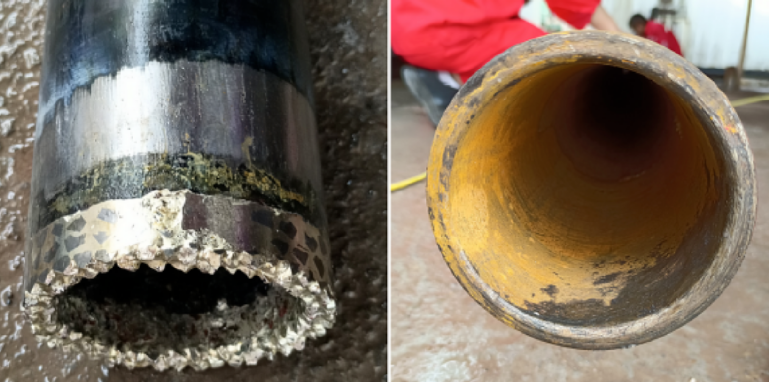
Landrill Oil Tools, a manufacturer of downhole tools, has expanded its milling tools portfolio with a new Milling Shoe series . The tools are engineered to clear debris, scale, cement, and other foreign materials from the annular space between downhole tubulars and the casing wall, restoring wellbore integrity for subsequent operations.
Purpose & Application
The Milling Shoe is a hollow milling tool used in workover operations to remove various contaminants lodged between the fish and the casing wall. It is also capable of milling annular cement, hardened sediment, gypsum, and mineral crystallization. The tool is run at the bottom of a washover string, with cut debris carried to surface by circulating fluid.
Structural Configurations
The Milling Shoe series is offered in two connection configurations to the washover string:
- Solid Type – integrated with the washover barrel.
- Detachable Type – separate from the washover barrel for flexible assembly
Carbide insert layout is available in three patterns:
Bottom unidirectional – mills in downward direction only.
Bottom + inner bore bidirectional – mills both down and inward.
Tri-directional – covers bottom, inner bore, and additional cutting faces.
Bottom profile options include guide-shoe type, flat-bottom type, wave type, sawtooth type, and crown type – selected according to formation hardness and the shape of the restriction to be milled.
Working Principle
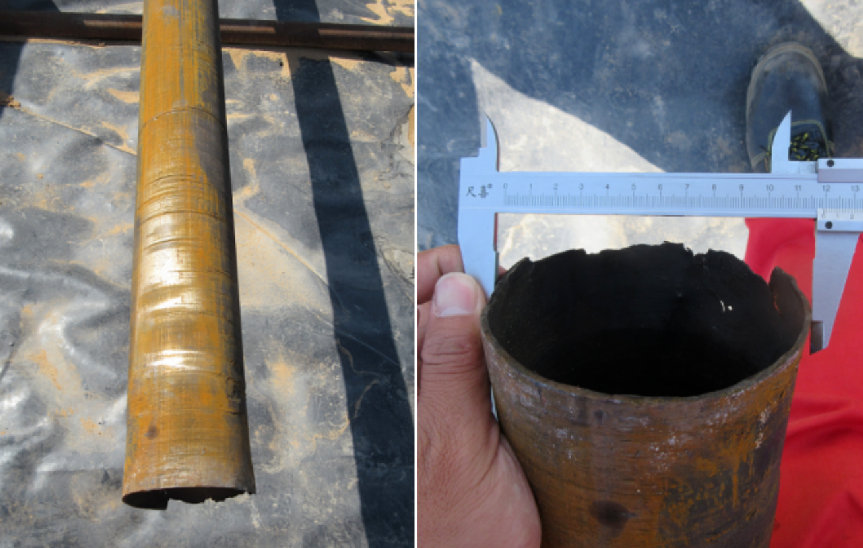
The tool relies on YD alloy inserts on its bottom face to mill debris and contaminants trapped between the fish and casing. Cuttings are lifted to surface by the circulating fluid, completing the wellbore cleanup process.
Controlled Milling Parameters
Based on extensive field experience, [Your Company Name] recommends the following operating envelope for safe and efficient milling:
- Run-in speed: controlled within 0.5 m/min; pump circulation when within 5 m of the restriction.
- Circulation velocity: annular return rate ≥ 0.8 m/s.
- Initial parameter: gradual weight application of 10–20 kN to locate the exact restriction; mark the position on the string.
- Rotation speed: 30–50 r/min.
- Cycle rule: lift the washover assembly to move it every 3–5 m of milling, but do not pull the shoe above the fish top.
- Principle: prioritize minimal sticking, fast ROP, and downhole safety.
Operational Excellence & Lessons Learned
Drawing from documented field cases, Landrill has codified critical operational safeguards:
- Long milling duration with sustained high weight can lead to alloy insert detachment and casing wall damage – parameters must be continuously monitored.
- When the shoe fails to enter the fish, do not force milling. Pull out, inspect shoe wear, analyze root cause, and adjust before re-entry.
- During milling, if severe sticking, jumping, no penetration, or abnormal pump pressure occurs, stop the operation immediately, pull out, and investigate.
- A magnet placed at the fluid return trough helps monitor steel cuttings in real time.
- Application-matched design: bottom profile and carbide layout are selected according to the specific job – no one-size-fits-all compromise.
- Controlled milling philosophy: documented parameter envelope prioritizes downhole safety over aggressive ROP.
- Failure-mode awareness: engineering team understands the failure mechanisms (insert loss, casing damage) and designs against them.
- Full workover integration: milling shoes are supplied as part of a complete washover string solution.
Why Milling Shoes
Contact : Jessie
Mobile/Whatsapp: +0086-18109206861
Email: energy@landrilltools.com
Web: http://www.landrilloiltools.com
Post time: Aug-07-2026


 5-1203,Dahua Industrial Zone, No.2 Yunshui Road,Hi-tech development zone, Xi'an, 710065,China
  86-13609153141

