



Basic Knowledge of Surface Christmas Trees (Dry Trees)
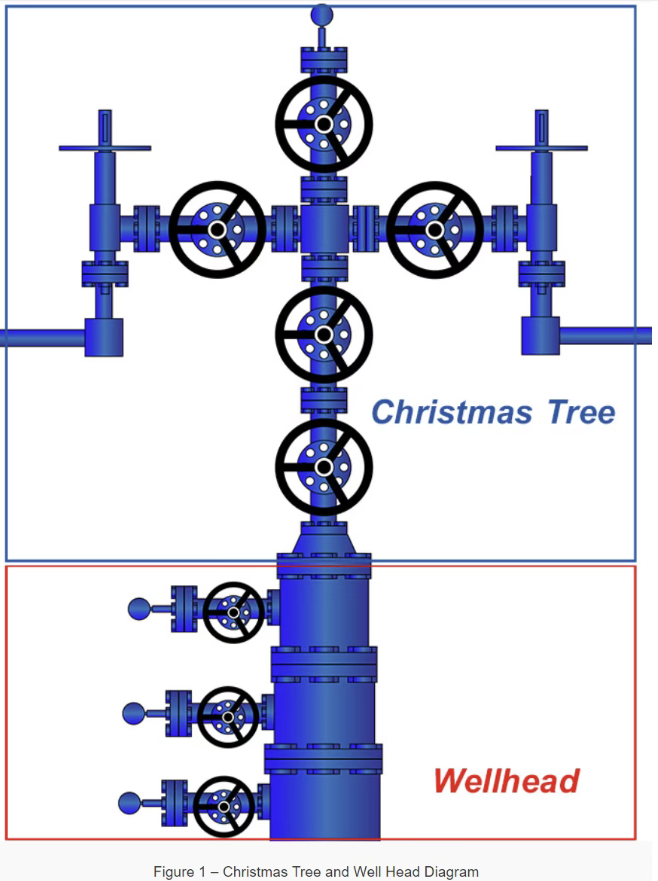
In the oil and natural gas industry, a “Christmas Tree” refers to a series of valves and spool assemblies installed atop an oil well. For land wells, it is installed on top of the last casing spool; for subsea wells, it is installed atop the high-pressure wellhead assembly. Figure 1 illustrates a schematic diagram of a “Christmas Tree” and the surface wellhead assembly. The Christmas Tree section is located at the top (within a blue box), while the wellhead section is the bottom part (within a red box). Many people confuse the concepts of “Christmas Tree” and “wellhead,” often believing them to be the same thing.
Its functions are as follows:
- To safely transport reservoir fluids from the well to the surface in a controlled manner.
- To provide safe access to the wellbore for performing well intervention procedures.
- To allow for water or gas injection operations.
- To provide hydraulic line connections for controlling downhole safety valves (SCSSSV).
- To offer electrical interfaces for instrumentation and equipment of Electrical Submersible Pumps (ESP).
This section introduces a surface “Christmas Tree” (dry tree), referring to any tree located above the waterline. A Christmas Tree consists of a series of valves, with its components described below.
Master Valve
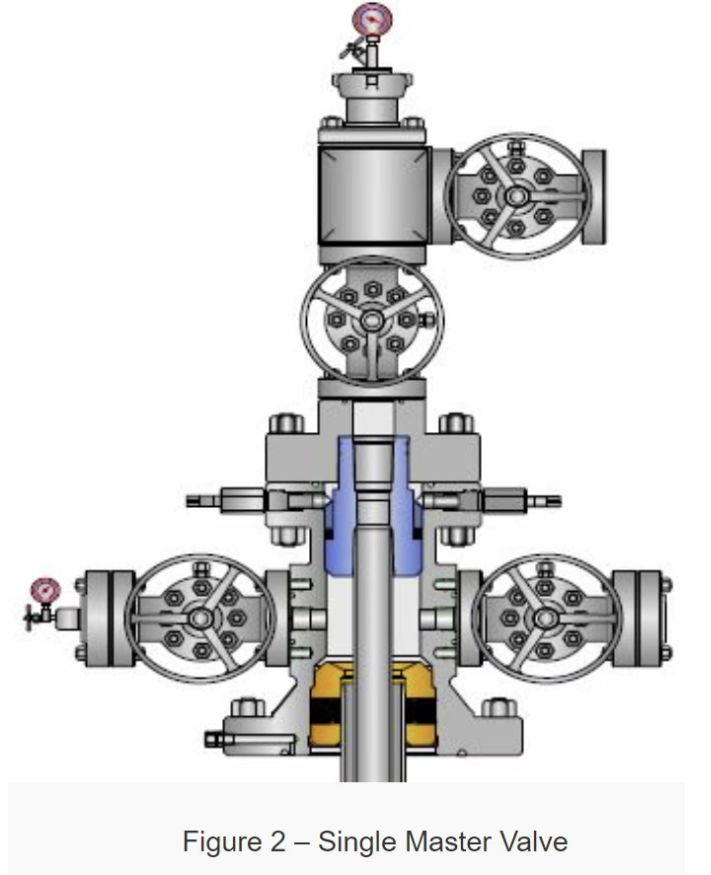
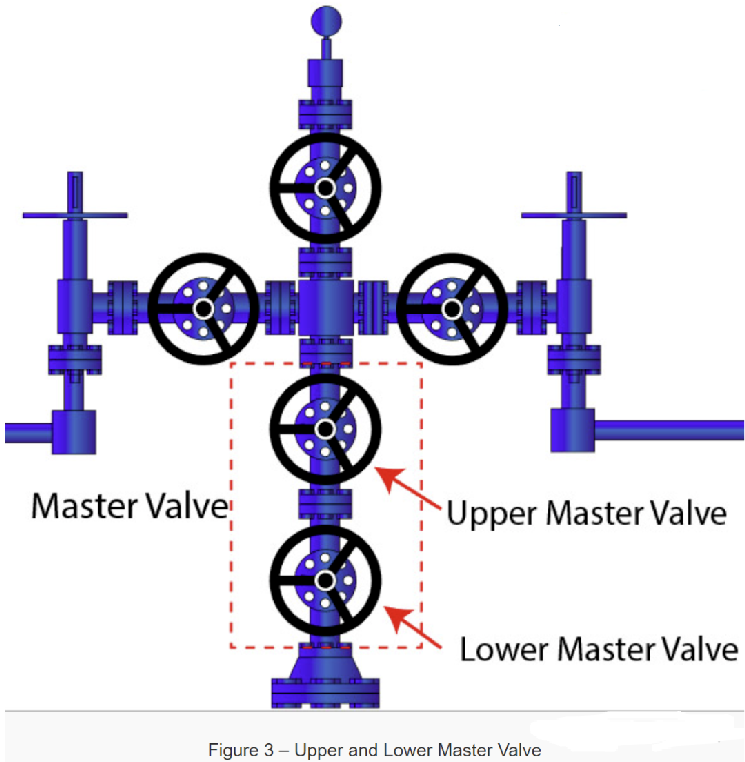
A master valve is located above the tubing hanger and serves to allow normal well operation or to shut in the well. Typically, there are two master valves: one is called the Lower Master Valve, and the other is the Upper Master Valve. Two valves are commonly used to provide redundancy; if one fails, the other can take over its function. Figures 2 and 3 show simple schematics of a single master valve and dual master valves, respectively.
Tee (T-Block)
The Tee (T-block) allows fluid flow to divert from the vertical pipe to the horizontal pipe.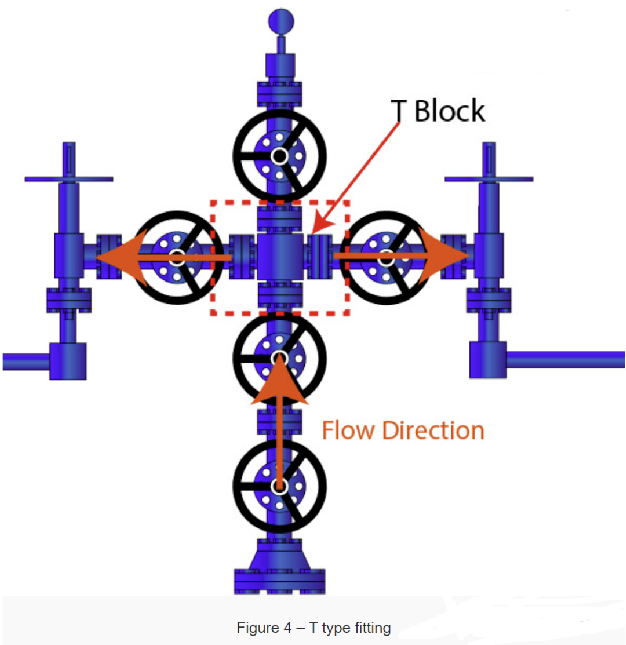
Figure 4- T type fitting
Wing Valve (Flow Wing)
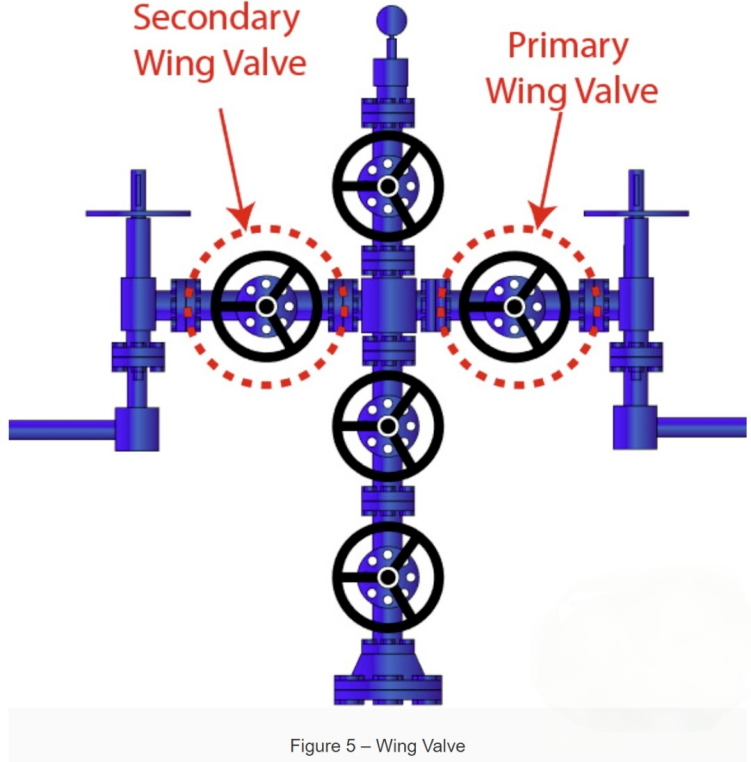
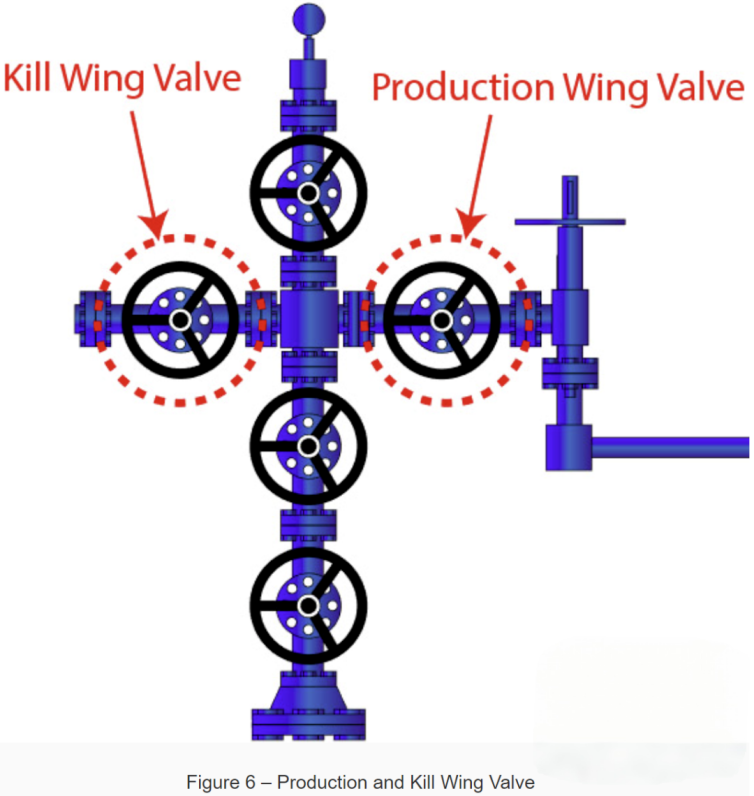
A wing valve is located on the side of the “Christmas Tree” assembly and controls or isolates the flow of well production to surface facilities. Depending on the design of the “Christmas Tree,” it may be equipped with one or two wing valves. Some operators require two production wing valves—one as the primary production valve and the other as a backup (see Figure 5). In many cases, one wing valve is used for production, and the other serves as a kill wing valve (see Figure 6).
Choke
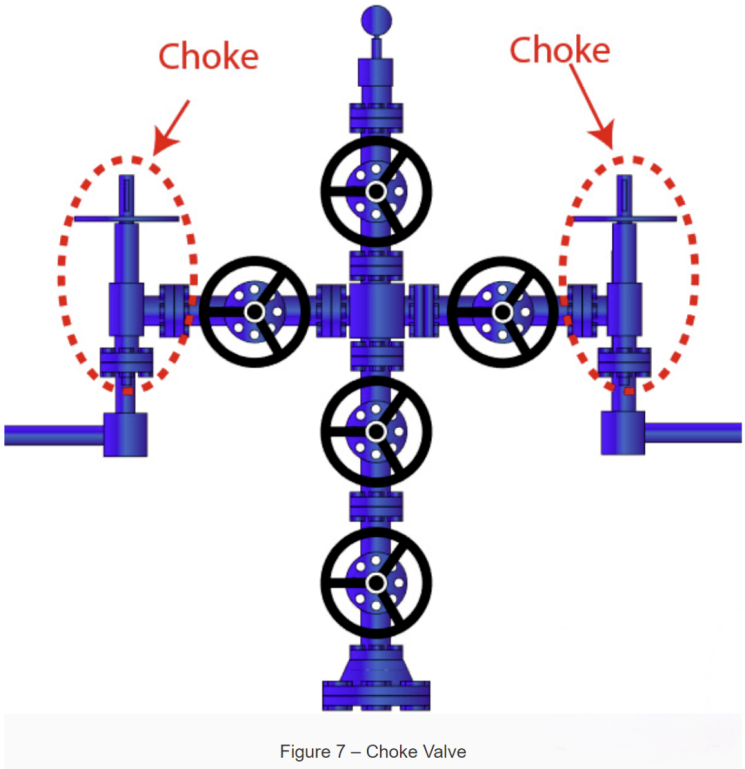
The “choke” is the smallest restrictive component in the Christmas Tree, functioning to control the oil well’s production rate. In some cases, it is also used to control sand production. A “choke” restricts the flow area of oil by inserting a small cylinder or orifice into the choke body. The smaller the cylinder diameter, the lower the production rate. There are two types of chokes: 1) Positive Choke (interchangeable cylinders) and 2) Adjustable Choke (easy to adjust the choke size).
Swab Valve
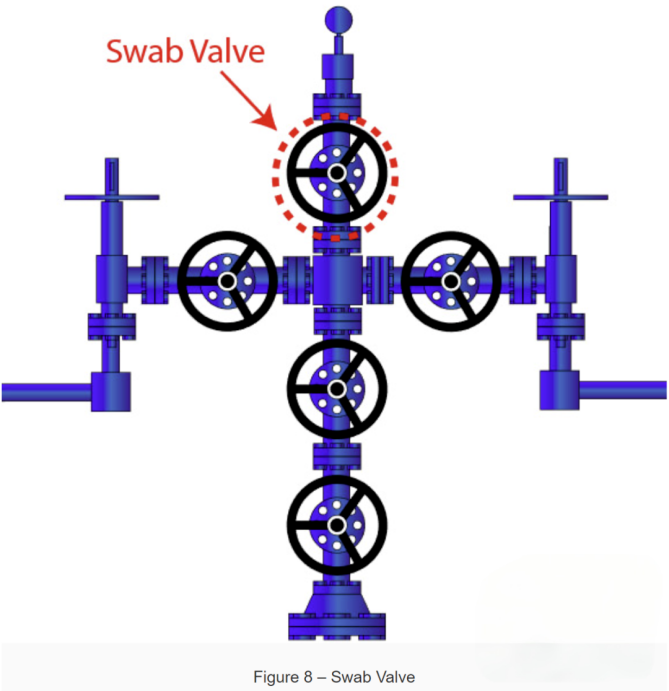
A swab valve is located at the very top of the Christmas Tree assembly, providing a vertical pathway into the well for wireline, slickline, coiled tubing, or rod pump operations.
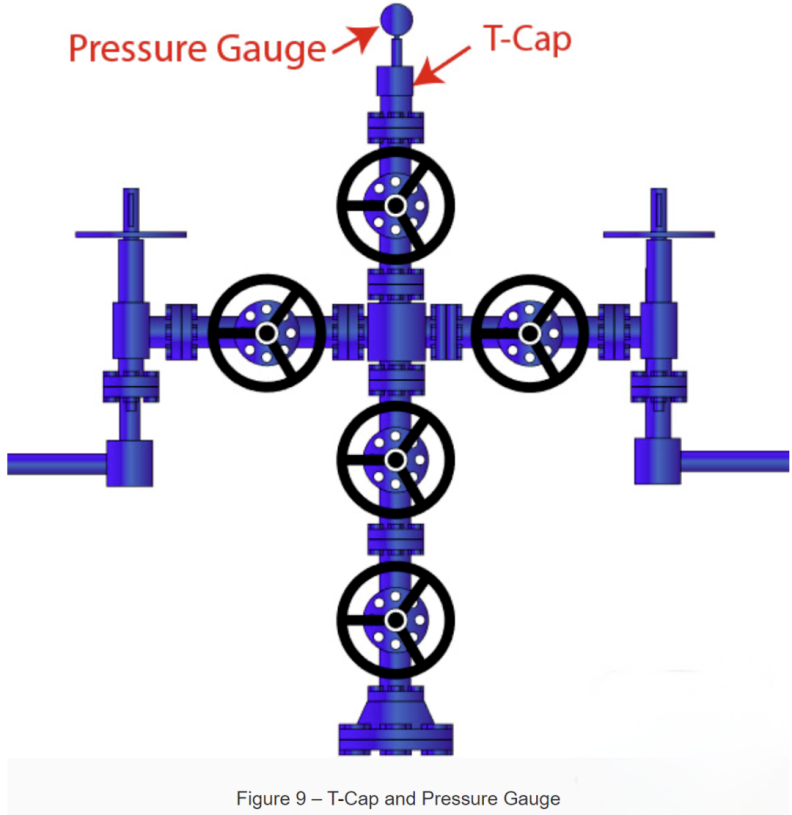
Tee Cap and Pressure Gauges
The T-Cap is a flange located at the top of the swab valve, allowing connection of wireline lubricators or coiled tubing/swabbing unit Blowout Preventers (BOP) to the well for performing well intervention operations. Pressure gauges are used to monitor well pressure. Nowadays, most operators typically use electronic pressure gauges to transmit pressure and/or temperature data via electronic systems for better well monitoring.
Contact :Jessie Zhou
Mobile/Whatsapp:+0086-18109206861
Email: energy@landrilltools.com
Post time: May-29-2026


 5-1203,Dahua Industrial Zone, No.2 Yunshui Road,Hi-tech development zone, Xi'an, 710065,China
  86-13609153141

