



The importance of tungsten (especially tungsten carbide) in petroleum drilling can be likened to it being the “industrial teeth” of the operation. It provides drilling tools with the decisive ability to continuously, efficiently, and reliably fracture rock while protecting themselves under extreme geological conditions. This perfect combination of hardness, toughness, high-temperature resistance, and wear resistance makes it a strategically critical and currently irreplaceable material. This is also why fluctuations in tungsten prices directly impact the entire petroleum drilling industry.
Below is a detailed analysis of the core reasons:
I. A Key Material for Overcoming Extreme Operating Conditions
Petroleum drilling—especially in deep wells, ultra-deep wells, shale gas horizontal wells, and offshore drilling—faces three major “extreme” challenges:
- Extreme Pressure and Temperature: At depths of several kilometers, temperatures can exceed 200°C, with pressures reaching hundreds of atmospheres.
- Extreme Abrasion: Drill bits must break through hard and abrasive formations (e.g., granite, flint, quartz sandstone).
- Extreme Corrosion: Drilling fluids may contain corrosive chemicals, brine, and hydrogen sulfide gas.
Tungsten’s Solution: Tungsten Carbide Hard Alloy
- Unmatched Hardness and Wear Resistance: Tungsten carbide is second only to diamond in hardness but offers far superior impact resistance and toughness compared to diamond. This allows it to act like “industrial teeth,” continuously cutting through rock under high-speed rotation and heavy load, with a service life tens to hundreds of times longer than ordinary steel.
- Excellent Hot Hardness: It retains high hardness even at elevated temperatures (up to ~1000°C), unlike many metals that rapidly soften and fail.
- Good Chemical Stability: It resists corrosion from drilling fluids and underground fluids.
II. Core Applications in Drilling Systems
Tungsten (primarily in the form of tungsten carbide and tungsten alloys) is integral to multiple critical aspects of drilling operations:
- The “Teeth” and Cutting Edges of Drill Bits:
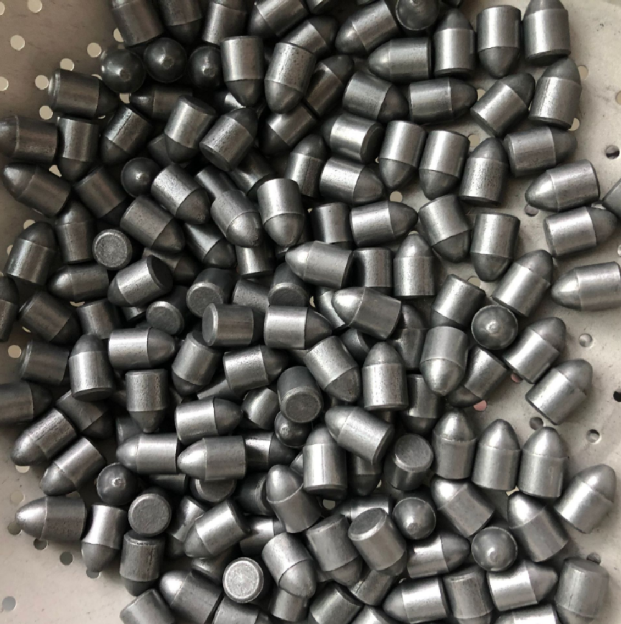
- Cone Bits: The “teeth” embedded in each cone are predominantly made of tungsten carbide. They are the front line in contacting and fracturing rock.
- Fixed-Cutter Bits: While PDC (Polycrystalline Diamond Compact) bits use diamond cutters for large-area shearing, gauge trimmers, heel teeth, and reinforcement inserts in critical areas often rely on tungsten carbide to prevent wear on the bit body.
- Specialty Bits: “Diamond Impregnated Bits” used in the hardest formations contain large amounts of tungsten carbide particles within the matrix, serving as both abrasive material and a support structure.
- Wear-Resistant Components for Critical Tools:
- Downhole Tools: The outer surfaces of MWD/LWD tools, stabilizers, and reamers are often hard-faced with tungsten carbide particles or studded with tungsten carbide inserts to resist severe wear from the wellbore.
- Drill String Components: Wear bands on drill pipe tool joints and heavy-weight drill pipe are coated with tungsten carbide to significantly reduce friction and wear against the casing, protecting the expensive tubulars.
- High-Density Weighting Material:
- Tungsten-nickel-iron alloys are used for weights in precision logging tools like MWD/LWD. Their high density (≈18 g/cm³) allows for significant mass in confined spaces, effectively stabilizing the tools and ensuring accurate data acquisition.
III. Direct Benefits—Why It’s “Irreplaceable”
- Enhanced Drilling Efficiency: Harder, more wear-resistant tungsten components lead to higher rates of penetration (ROP) and longer footage per bit run, directly reducing well construction time.
- Ensured Operational Safety and Reliability: A sudden failure of a bit or tool thousands of meters downhole can result in costly fishing jobs or even loss of the well. The exceptional reliability of tungsten components is key to operational continuity.
- Lower Overall Cost: Although tungsten materials are expensive, the benefits—reduced tripping time for bit changes, lower failure rates, and higher total drilling footage—lead to a significantly lower cost per meter over the entire lifecycle.
- Enables Extreme Operations: Without tungsten-based hard alloys, drilling many of today’s wells exceeding 5,000 meters in depth (deep/ultra-deep wells) and complex well geometries would be technically or economically unfeasible.
Post time: Jan-13-2026

 5-1203 Dahua Digital Industrial Park Tiangu 6th Road,Hi-tech development Zone Xi'an, China
  86-13609153141

