



Casing Centralization
Using casing centralizers is an important measure to improve cementing quality.
The purpose of cementing is twofold: first, to isolate unstable, lost-circulation, or other complex intervals with casing, thereby providing protection for continued safe and smooth drilling; second, to effectively isolate different oil and gas zones, preventing oil and gas from migrating to the surface or migrating between formations, and providing a conduit for oil and gas production.
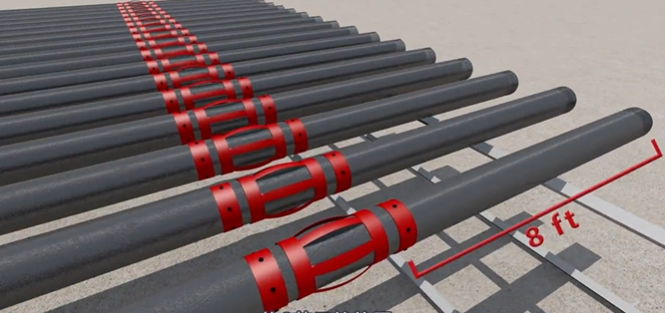
Based on the purpose of cementing, criteria for evaluating cementing quality can be established. Good cementing quality mainly means that the casing is centered in the wellbore, and the cement sheath around the casing effectively separates the casing from the wellbore wall and isolates different formations from each other.
However, actual drilled wellbores are not absolutely vertical and will have varying degrees of deviation. Due to wellbore deviation, the casing will not naturally be centered in the wellbore, resulting in different lengths and degrees of contact with the wellbore wall. This creates varying annular clearances between the casing and the wellbore wall. Where the clearance is large, the original mud is easily displaced by cement slurry; conversely, where the clearance is small, due to higher flow resistance, the cement slurry is difficult to displace the original mud, forming what is commonly referred to as cement slurry channeling. Once channeling occurs, oil and gas zones cannot be effectively isolated, and oil and gas will migrate through sections without a cement sheath.
The use of casing centralizers is to keep the casing as centered as possible during cementing. For directional or highly deviated wells, casing centralizers are even more necessary. In addition to effectively preventing cement slurry channeling, casing centralizers also reduce the risk of differential sticking of the casing. Because the centralizer keeps the casing centered, the casing does not rest against the wellbore wall; even in permeable intervals, the casing is less likely to become stuck due to mud cake formed by differential pressure. Casing centralizers also reduce the bending of the casing in the wellbore (especially in large-diameter sections), thereby reducing wear on the casing by drill strings or other downhole tools during subsequent drilling operations, thus protecting the casing. Due to the support provided by casing centralizers, the casing string can be moved more easily during cementing operations.
In summary, the use of casing centralizers is a simple, practical, and important measure to improve cementing quality.
Contact :Jessie Zhou
Mobile/Whatsapp:+0086-18109206861
Email: energy@landrilltools.com
Post time: Apr-22-2026


 5-1203,Dahua Industrial Zone, No.2 Yunshui Road,Hi-tech development zone, Xi'an, 710065,China
  86-13609153141

