



A Rotary Steerable System (RSS) is a steerable drilling system that, while the drill string is rotating, monitors and controls the rotation of the drill pipe in real time to perform steering functions, enabling drilling operations to reach the target formation more precisely. It is widely used in directional wells and horizontal wells.
I. Directional Drilling
Directional drilling is a drilling technology that uses specialized downhole tools, measurement instruments, and techniques to effectively control the wellbore trajectory, allowing the drill bit to reach a predetermined downhole target along a specific direction. In essence, directional drilling is a method of drilling a wellbore that follows a pre-designed deviation angle and azimuth to reach the target zone.
The main profile types include three categories:
- Two-section profile: vertical section + build-up section
- Three-section profile: vertical section + build-up section + tangent section
- Five-section profile: upper vertical section + build-up section + tangent section + drop-off section + lower vertical section
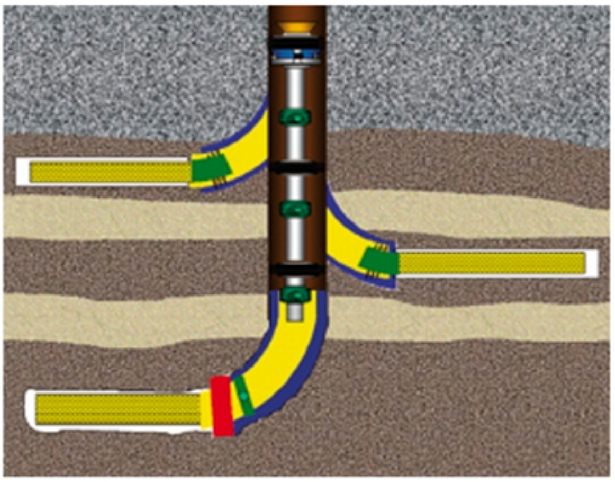
Three milestones in directional drilling technology:
① Use of a whipstock (deflecting tool) for directional drilling
② Use of a downhole motor combined with a bent sub for directional drilling
③ Use of a steerable motor (bent housing downhole motor) for directional drilling
II. Horizontal Drilling
Horizontal wells are a type of directional well. Conventional oil wells are vertical or deviated through the reservoir, with a relatively short section passing through the reservoir. In contrast, horizontal wells are drilled vertically or deviated down to the reservoir, and then the wellbore turns to nearly horizontal, running parallel to the reservoir and drilling a long section through it until completion. Such wells can pass through the reservoir for hundreds or even over two thousand meters, facilitating greater oil recovery. The flow resistance of reservoir fluids entering the wellbore is reduced, resulting in production capacity several times higher than that of ordinary vertical or deviated wells.
Back to RSS
RSS offers advantages such as reduced friction and torque, high rate of penetration (ROP), low cost, short well construction period, smooth wellbore trajectory, easy controllability, and extended horizontal section length. It mainly consists of a downhole rotary steerable system, a surface monitoring and control system, and a two-way communication technology linking these two components.
RSS can be classified by the operation mode of its steering mechanism into static bias and dynamic bias. By steering principle, it can be divided into push-the-bit and point-the-bit systems.
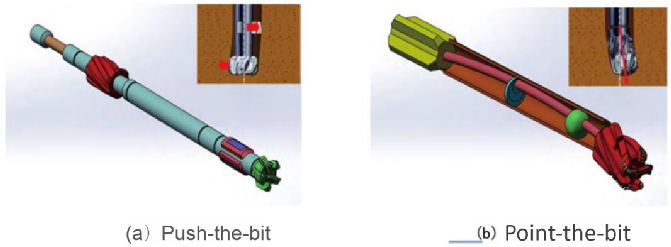
① Push-the-bit
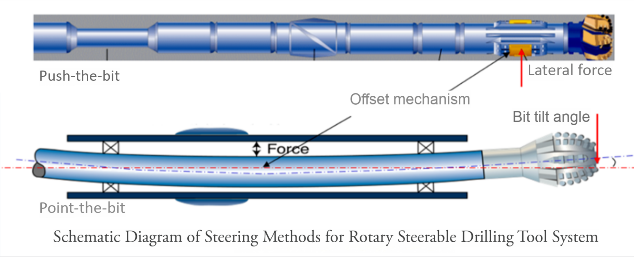
This system directly applies lateral force to the bit near the bit. The offset stabilizer of the push-the-bit rotary steerable bottom hole assembly (RSBHA) is placed close to the bit, with several drill string stabilizers connected in series behind it. During steering, the deflection force generated by the eccentric steering tool causes the RSBHA to deflect and build angle. (This often results in a pronounced helical wellbore shape, poor hole cleaning, and effective wellbore diameter shrinkage, i.e., the cross-sectional size of the wellbore becomes smaller than the bit diameter.)
② Point-the-bit
This system steers the bit toward the desired wellbore trajectory by bending the drill string near the bit. The offset stabilizer of the point-the-bit RSBHA is placed between two stabilizers, achieving rotary steering mainly through the bit angle. (Better wellbore quality, with maximum dogleg severity exceeding 15°/30m.)
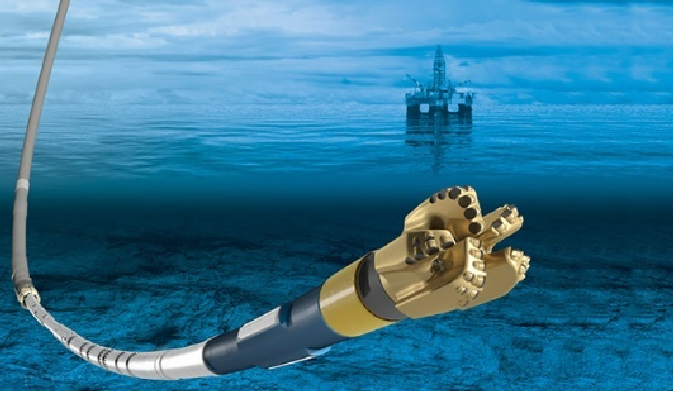
RSS Systems in International Use
Schlumberger: PowerDrive (XCEED, ARCHER, PV)
Halliburton: Geo-Pilot
Baker Hughes: AutoTrak
Weatherford: Revolution
Contact :Jessie Zhou
Mobile/Whatsapp:+0086-18109206861
Email: energy@landrilltools.com
Post time: May-15-2026


 5-1203,Dahua Industrial Zone, No.2 Yunshui Road,Hi-tech development zone, Xi'an, 710065,China
  86-13609153141

